Wenchuan Earthquake (also called 512 Big Earthquake and 2008 Sichuan Earthquake) is the 8.0 magnitude earthquake occurred in China’s Sichuan Province at 2:28 PM on the 12th of May 2008. Wenchuan County is the epicenter of the quake. The direct economic losses are over 845 billion Yuan. Around 70000 people died and over 18000 people missed in this earthquake. Therefore, Wenchuan Earthquake is the deadliest disaster for more than 30 years in China. It is one of the worst ever recorded regard with the terms of casualties.
The Chinese government has contained a strict control on the media when it comes to disaster reporting. However, the propaganda on the Wenchuan earthquake in 2008 was overwhelming. (Ye, 2015). The direct purposes may be that the Chinese government wants to collect public resources as much as possible for rescue, to operate post-disaster reconstruction, to recover the damage to the international image caused by the Lhasa violence in March 2008, and to provide a good environment for the 2008 Beijing Olympics. After 2008, every 12th of May is still an important national memorial anniversary for the country. In 2018, Around the 10th anniversary, the discussion about Wenchuan Earthquake in media discourse reached the second peak again. (Ye, 2015). Today the Wenchuan Earthquake and its media representation have still maintained their role in building national memory and preventing disasters. This virtual museum will use multiple media to understand how Wenchuan Earthquake has been mediated to be a tool of social mobilization and politics as well as a collective memory for Chinese
People Liberation Army
Among all the reports and television programmes about the Wenchuan Earthquake, contents about how People Liberation Army (PLA) and government leaders participated in the rescue activities have been released as an inseparable part. These media contents emphasized the difficulties of rescue, like the collapsed traffic, bad terrain and weather conditions. The effort the PLA made to save people was also addressed by describing the details such as the number of rescue soldiers and the various types of equipment. This is the most prominent manifestation of the instrumentalization and politicization of the historical event of the Wenchuan Earthquake.
By mediating the PLA in a positive attitude, the government aims to transmit emotions like hope and trust. Therefore, they can reduce citizens’ panic and potential anti-government sentiment, increase citizens’ confidence in the PLA, cultivate a sense of patriotism and eventually enhance the national identity and collective memory for Chinese people.
Personal Stories
Moreover, the mainstream media of China also reported massive stories about heroes and ordinary people to strengthen national solidarity and national cohesion.

Collective memory is the abstraction and promotion of many personal memories and emotions and the basis of a community’s self-identity (Neal, 2005). On the one hand, these presentations trace back to the situation of the earthquake and the situation after the earthquake through individual stories. On the other hand, the love between mother and children is one of the most general memory in the society, therefore, an emotional resonance can be created between citizens and these television programmes. It helps to engage their individual memory with collective memory.
The Memorial sites
More than the effort on journalism, many museums, ruins parks and monuments related to the Wenchuan earthquake have been built after the Wenchuan Earthquake too. The natural phenomenon of “earthquake” has formed the “earthquake heritage” through the participation and construction of human activities and the process of “inheritance”. (Yang, 2014).
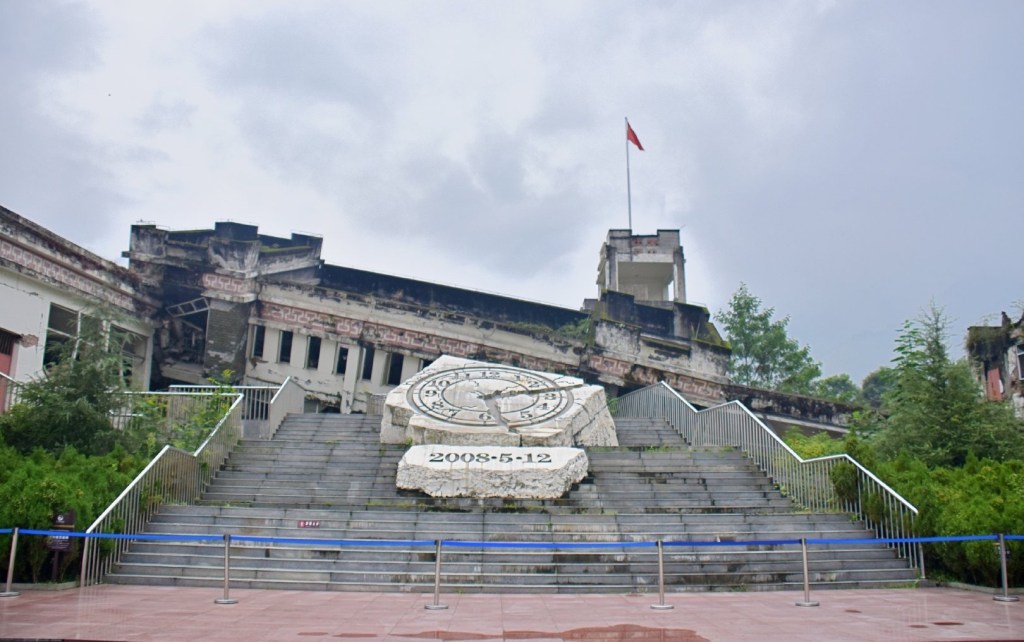
The museum of the Wenchuan Earthquake, built by Jianchuan Fan since June of 2018, is the most famous memorial site for this earthquake. Three galleries are included in this museum: Shocked 5 / 12 to 6 / 12 Diary Museum, Earthquake Science Popularization knowledge Museum and earthquake Relief Art Museum. Heritages like the equipment of PLA used for rescue were collected and exhibited. It shows the diverse forms to construct collective memory. By providing reconstructions of the earthquake through the sounds, smells and visual design, immersive experience for visitors is created. Their memory about the Wenchuan earthquake can be recalled and enhanced too.
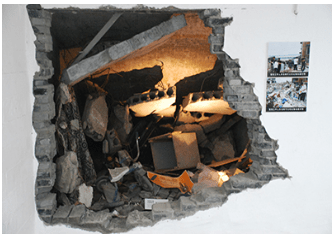
Notably, a unique heritage in the museum might be Strong-willed Pig, a pig survived after 36 days covered under the ruins.
As mentioned in this video, Strong-willed pig helps citizens to memory the past. It offers an integrity and continuity of the collective memory. Additionally, she also symbolizes “a cherish of life” and a sense of hope and rebirth. From this perspective, she can be regarded as a healing for this traumatic memory.
Forgetting
The media construct the collective memory of the Wenchuan Earthquake by repeating and updating the historical topics through multiple media like journalism and memorial sites. However, forgetting is also a vital method to control this collective memory. With the emphasis on collapsed school and the vast number of dead children, critical and inquiry about the corruption in the field of school architecture emerged.
Nevertheless, China employed Repressive Erasure mentioned by Connerton (2008) to avoid relevant information on corruption being engaged into the national memory for Chinese. However, in this age of digital memory, citizens could still access to these critical mediations of the past. These videos increase the flexibility of the collective memory of Wenchuan Earthquake.
My connection with the Wenchuan Earthquake
I am a person who experienced the Wenchuan Earthquake. I was living in Chengdu, where is 159 kilometers away from Wenchuan. I remember when it happened, I was nine years old. At 2:28 PM that day I was walking with my friends to go to my primary school, the first class is P.E., so I was excited. Suddenly, I saw the sand and gravel fell from the building and people all rushed into the street in a panic. I was terrified. I could not contact my mother because all the telecom was invalid at that moment. After I finally found my parents in the evening, to keep safety, all the people sleep outside the buildings. For a long time after that, I always woke up in the middle of the night. Even if the skyline turns a little red, I would worry about whether it is a signal of an aftershock. The experience in the Wenchuan Earthquake is a vital point in my life and I was an audience of those mediations. Engaged my memory with the collective memory, Wenchuan Earthquake helps to construct my identity and a feeling of belongings to a community. Therefore, I hope this trauma can become a postmemory for my children in the future
Reflection
This virtual museum recorded the memory of the Wenchuan Earthquake, its importance as a history event and clarified how the collective memory of this earthquake has been constructed. From the angles of journalism, memorial sites and forgetting, I exhibited how the earthquake is mediated in a political and positive way to generate collective memory for Chinese people. During this process, I used multimedia format to provide an easier and more exciting experience to understand information in this exhibition. Additionally, I also related my personal memory with this earthquake. However, a limitation of this virtual museum is that while I concentrate on the “National will”, some information about how society constructs the collective memory may be ignored. For instance, the “grey joke story” in Wenchuan Earthquake refers to the stories which have the feature of black humor (Ye, 2015). An example is the story of “Cola Boy” who said he wants a cup of cola and it must be cold after he was saved from the ruins after 80 hours of the earthquake. To improve the understanding of how the Wenchuan Earthquake is mediated as a collective memory, this type of information may also be essential.
Reference
Connerton, P. (2008) ‘Seven types of forgetting’, Memory Studies, 1(1), pp.59-71.
Neal, A. G. (2005) National Trauma and Collective Memory Extraordinary Events in the American Experience, New York:Routledge.
Yang, X. 2014). ‘A Re-thinking of the Wenchuan Earthquake Heritage’, South East culture, 6, pp.12-18. [Online]. Available from: http://www.cqvip.com/qk/82619x/201406/68788772504849524854484851.html (Accessed: 11 December 2019)
Ye, J. X. (2015). THE WENCHUAN EARTHQUAKE AS A MEDIATED DISASTER IN CHINA: HOW THE MEDIA REPRESENTED AND RECONSTRUCTED THE DISASTER, Thesis (PHD), NATIONAL UNIVERSITY OF SINGAPORE. [Online]. Available from: file:///C:/Users/25055/Downloads/YeXJ.pdf (Accessed: 11 December 2019)
 Neverexisted ocean